
December 2, 2018 by Starhawk
We Live in Extreme Times
In the recent elections of November 2018, we have seen more women, LGBTQ folks and people of color elected to positions of power.
At the same time, we’ve seenan anti-choice judge confirmed to the Supreme Court who threatens women’s right to choose.The Trump administration is attempting to define transgender folks out of existence and mount an assault on their rights.States pass Draconian restrictions on abortion—and all this and more is just in the last few months!
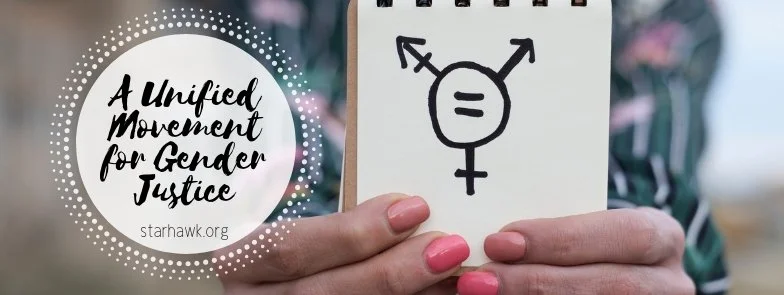
We need a unified movement for gender justice—a movement that sees itself as one facet of an even broader justice movement that also works for racial justice, immigrant justice, religious freedom, and all forms of human rights and self-determination.
Too often we have seen the movement for trans and nonbinary rights as separate from the movement for women’s rights that arose from the second wave of feminism. That division only serves to reinforce the structures of authoritarian male rule.Our issues are not separate, and our interests are far more common than they are divided.
A Unified Movement Can Be Built on a Framework of Human Rights
If we see our interests as united, then we can build a unified movement around our basic human rights.
The right to self-determination: the right to define for ourselves who we are and how we present ourselves in the world.
The right of bodily sovereignty: our human right to determine what happens to our bodies, to have our boundaries respected and our bodily integrity inviolate, and to make our own choices.This right encompasses the right of a pregnant woman to choose whether or not to bear a child, the right of nonbinary folks to redefine what gender means to them and to choose how they live in the world, the right of those who need it to have access to birth control or hormones or surgery, the right to research that might inform decisions about medical interventions of all sorts and the right to make those decisions for oneself, the right of all genders to be free from rape or harassment, and more.All of these are linked, and we need to stand in solidarity with one another to defend them.
The right to be our own moral authority: Politics, media and social media pressure us to stake out clear, simple positions and defend them vehemently.But many decisions are complex.Whether or not to have an abortion, whether or what type of medical intervention to seek—so many of the choices we make around issues of sex, gender, biology and identity are actually very deeply personal and intimate, and don’t always fall into easy sound-bites.We have the basic human right to struggle with that complexity ourselves, to choose our own advisers, define our own guiding principles, and be the arbiters of our own conscience.
A Clear Critique of Patriarchy
An understanding of how patriarchy functions would also be key to a unified movement to counter it.Patriarchy reinforces the rule of a few over many by keeping us divided.It enlists men in its service by offering them entitlement to women’s bodies and the bodies and services of all those of lesser power.
For male supremacy to rule, gender must be strictly binary and divided—men must be manly men and women womanly to keep us insecure, striving to live up to gender ideals.Women are assigned the realm of nurturing, caring, and feeling—a realm which is devalued.Protection, aggression, assertiveness and violence are assigned to men—and overvalued.The strong are revered and the weak despised.
Male supremacy is the twin of white supremacy—they march together and reinforce each other and we cannot defeat one without also challenging the other, along with their brothers and cousins of all sorts of discrimination and economic oppression.
The women’s movement that arose in the late ‘Sixties and ‘Seventies did the heavy lift of identifying patriarchy and naming the damage it inflicts.Today, younger activists are often challenging the construct of gender altogether, pushing its edges into new and creative places.Both strategies are important ways of challenging the current structure of power, and they do not need to at odds with each other.Each has their own strengths and limitations, and each might be used more effectively if we can build a unified movement for gender justice.
A Framework of Solidarity and Restorative Justice
A unified movement must be built on a framework of mutual solidarity—that we agree to stand together and support one another around these goals.Solidarity does not mean that we agree on everything, or that we like each other, or that we don’t sometimes have grave differences of opinion on serious issues.It means that we agree to support one another on these basic rights, regardless; that we understand we have vital interests in common and opponents who threaten us all.It also means that we seek ways to engage in meaningful dialogue, constructive critique, and mutual education and relationship-building.
What do we do, then, when one of our allies does something we truly find hurtful or offensive?Most often in our movements our immediate response is to demand they be cast out, ejected from community, or silenced.The intention is protective, to make our communities safe, especially for those who have been targets of oppression. But often the impact is very different—for those responses create a frame of transgression and punishment which is itself authoritarian and binary and often shatters community.
Instead of creating safety, radical spaces come to feel less and less safe when anyone can be cast out.Moreover, history shows us that liberatory movements that take the route of purification and purges become repressive when they gain power, but more often, self-destruct along the way.
Instead, we can adopt a framework of restorative justice, which has been proposed and used successfully as a counter to the deeply unfair and damaging criminal justice system.Restorative justice has the aim of supporting the community as a whole.When someone does harm, they tear the fabric of community.
Justice aims to mend that rip, not to cast out the offender but to stop the harm, assure accountability, and as far as possible, heal the wounds.Offenders who take responsibility for their actions and make amends are offered a path back into community.
Trauma and Healing
Speaking out about these issues feels risky. The level of pain, outrage and sheer vehemence that erupts on social media when these subjects are broached can be hurtful and intimidating. The intensity is often rooted in the legacy of trauma and pain we carry from living under a supremacist system that condones assault and violation. Yet when we respond out of unhealed trauma, we may inadvertently cause further pain. We may lash out at our allies, or attempt to protect ourselves or others by adopting a framework of condemnation, silencing, banishment and punishment that comes from the very system we are fighting.
A unified movement for gender justice must include awareness of the affects of trauma and offer tools for healing.We need ways to grieve our losses together and support one another’s resilience and strength.For if we allow unhealed pain to drive us apart, we will be less effective in countering the system that generates the trauma.
In an era of the rise of right-wing neo-fascism and increased assault on all or our communities, we need both the insights that arose from second-wave feminism and the gender challenges and creativity of the third wave.Our movement will be far stronger if we seek for ways to complement and support each other and work together.Our lives and our future are at stake.