
December 2, 2016 by Starhawk
The sign at the main entrance to the Oceti Sakowin camp at Standing Rock says, “This is a place of prayer and ceremony.”
To be honest, I was afraid to go to Standing Rock.
Not so much of the cops, despite their violent assaults on peaceful protestors, but of the cold and the discomfort. In my mind, I’m like those wizened, tough old biker crones in Mad Max—but in reality, I’m a fat old lady with asthma, arthritic knees and a compulsion to pee multiple times throughout the night, and camping out in freezing weather is no longer something I contemplate with alacrity.Moreover, the crisis in North Dakota and the election crisis coincided with various personal crises that culminated with the urgent necessity of packing up pretty much everything in the house I’ve lived in for thirty years to prepare it for renovations and partial sale, and a related financial crisis. So it wasn’t the best time to go—but the Thanksgiving weekend seemed to be about the only window of time I could go, and the weather wasn’t going to get warmer.I also wrestled with the question of what my role should be as a white ally of an indigenous-led movement. Was it an act of colonial violence for me to come, an assertion of white privilege? Should I just donate the money my ticket would cost, and stay warm?But I’m a public person, with a platform of writing and speaking, and I knew I would be a more effective advocate if I went there myself. And I hoped to be able to make some contribution. My training collective, Alliance of Community Trainers, would be there, and my old action buddy Lisa Fithian had been there for weeks and was organizing actions. So I interrupted my marathon of packing and cleaning, and went.
And as soon as I saw the sign, I knew I was right to come. For decades, I’ve been writing and speaking, organizing and teaching around the simple concept that spirit and action go together. Activists need some kind of spiritual base to sustain what is very hard, sometimes dangerous, and often frustrating work. And spiritual folks need to be engaged with the world, taking action to alleviate suffering and protect the sacred.So how incredibly affirming it was to walk into a place where everything is grounded in ceremony and every action is seen as embodied prayer. Lakota spirituality is not my tradition, although deeply aligned in values and world view. But I have no authority or permission to hold ceremonial energy or lead—and so I was blessedly free to listen, absorb, and do my personal work in a way that I rarely get to do in my own tradition.I sat at the Sacred Fire and listened to people speak from the heart about the struggle. I got up early to go to the water ceremony, led by women, where we processed down to the Cannonball River to offer tobacco. I was given permission to offer our Waters of the World, and when an Irish-American woman gave some water from Brigid’s Well, I asked to share one of our Brigid Chants at a time when many people were sharing songs.I sat in meditation at the Global Prayer for Standing Rock, and heard one clear message that said to me: “White people can’t heal until they come to terms with the Witch persecutions.”
For so many decades, I’ve been writing and teaching about the forgotten heritage of the ancient Goddess traditions in Europe and the Middle East. I’ve been working to recover, or create, the rituals and ceremonies that link us to sacred nature and community. I’ve proudly called myself a Witch, in an attempt to uncover and reclaim that heritage.And I’ve also gotten worn down, tired of endlessly explaining the same things over and over again, tired of fending off the same nervous jokes or correcting the same misunderstandings. I’ve been more excited to learn the practical ways of earth-healing, to share the formula for compost tea rather than the esoteric formula for some magic spell.
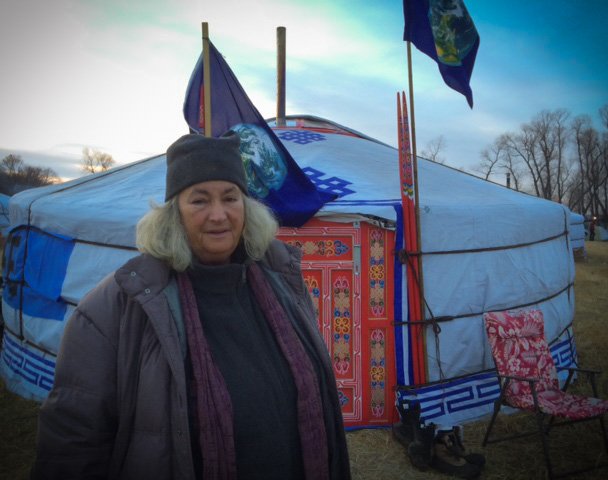
But over and over again, at Standing Rock and elsewhere this year, I’ve been brought back to the importance of that early work. Young people simply do not know the Goddess history—and for people of European heritage, it is vital to know that we also have indigenous roots, have ancestors who knew that water is sacred, and traditions we can connect to that can help us anchor in the land. So many people hunger for that connection—and we don’t have to take it from someone else although we should always be willing to listen and learn from other cultures.Sunday was our day for a women’s action. Lisa had arranged for me to connect with Cheryl Angel, a Lakota elder who was leading the action and to stay in her yurt. We woke before dawn for a women’s sweat, poured by a Dineh poet, singer and songwriter Lyla June. As I stumbled out into the dark and cold and found my way to the fire, I noticed Lyla June was wearing a tee-shirt emblazoned Boudica—the ancient British woman warrior who led an uprising against the Romans. A Statue of Boudica in London. Boudica was a queen of the British Celtic Iceni tribe who led an uprising against the occupying forces of the Roman Empire.A group of about twenty or more women undressed and crammed into the lodge, and Lyla June spoke to us from the heart about her life and sacredness of water.
Then she began to talk about the Witch persecutions—about how the brutal murder of women in European history has separated those of us with that heritage from our indigenous roots. I was amazed, and again felt deeply affirmed. After the sweat, I led a training for over a hundred people in some of the magical activist tools we’ve developed for nonviolent direct action. Then we scrambled to get ready for the action—a march through the camps and out onto the bridge and the barricades that separate us from the drilling sites.The march through camp was beautiful—although at a faster pace than I would have preferred. Cheryl Angel was very determined to have a silent, prayerful action, and people were very good about holding the container of silence. I was mostly praying not to have an all-out asthma attack before we even got to the barricades, and thankfully that prayer was answered.The elders at Oceti Sakowin had asked that no one do actions that weekend, in order not to divert attention from the eviction notice, and because they were worried that actions might not be completely nonviolent. But we had received permission from one of the elders, who asked that we stop at the Sacred Council Fire to do ceremony. When we got there, however, we found that the elders were not in agreement. Some of them wanted us to go back—but Cheryl listened respectfully, and then simply led us on.At the barricades, the next obstacle was our own security, who were acting more like cops than cops, telling us we had to go back, that they had ‘orders’. Eventually, they let the elders through, and I followed Cheryl, LaDonna who is from the area and owns some of the land we’re camped on, and a group of others, including another Reclaiming Witch, River.
I stood behind Cheryl and listened to one of the most powerful moments of pure nonviolence I’ve ever experienced. She prayed aloud, apologizing to the earth and the waters for our failure to protect them, speaking to the police who stood on the other side of the barrier and telling them that our prayers were for them, too, and for the safety of their children and grandchildren. She spoke with such heartfelt power, sometimes crying, sometimes smiling—and I was watching the faces of the officers change, from that stone-faced cop look to meeting her eyes. I saw their faces soften, and saw them begin to nod. LaDonna spoke, telling them how she had grown up there, how she knew them and had gone to the same schools, how her father had been a law enforcement officer. By the end, when Cheryl told them we were going down to the river to do ceremony, they agreed.Although I’ve written about nonviolence, practiced and trained people in it for decades, I generally think of it as a great experience. I am ever-hopeful, but rarely convinced, that we can truly change the hearts of our opponents, and more often think of it as a strategy to galvanize the hordes of those who are unconvinced or uninformed, and marshall political pressure on our opposition.
But listening to Cheryl, I began to to believe that maybe we can invite even the police to our table, that maybe a strategy for this time of ever-consolidated power might be, as I wrote in The Fifth Sacred Thing, to fight on the terrain of consciousness, to contest not the guns but the mind that chooses whether or not to use the gun. “Consciousness is the most stubborn stuff in the cosmos, and the most fluid. It can be rigid as concrete, and it can change in an instant. A song can change it, or a story, or a fragrance wafting by on the wind.”We went, down a steep bank and over muddy ground. I stood behind Cheryl and was able to give her some of our Waters of the World, water we have used in ceremonies and for offerings at sacred places for more than thirty-five years, that includes waters from every continent and ocean and many, many political actions. She gave it to the river, with prayer.Then we walked back. The action was over, the silence held. Will the prayers be answered? That will depend on the support and the political will we can all muster in the coming weeks.For myself, I am grateful I decided to go, and even more grateful and humbled by the immense commitment and faith shown by the water defenders.I had to leave the next day, as the weather changed and a blizzard blew in. This week, with the eviction notice, the struggle intensifies. Please send prayers and every form of support to those who will remain in much rougher circumstances than I experienced.
Water is sacred! Water is life!
This article, from Indian Country Today Media Network, outlines many of the options for giving material support to the struggle. The Reclaiming Spiral Dance cell is donating $500 to the legal collective. If you are in a position to give material support, these are the most pressing needs right now.